

The President cannot unilaterally impose tariffs on any country through his executive orders.
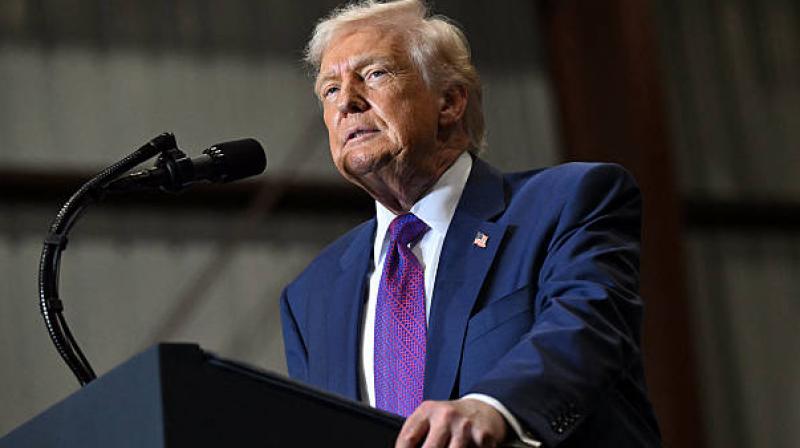
US Supreme Court decision is a relief for India Editorial: Despite the country's Supreme Court declaring the unilateral tariffs imposed by US President Donald Trump as unconstitutional and illegal, the prospect of an immediate improvement in global financial instability remains dim. The nine-judge Supreme Court ruled on Friday by a 6-3 majority that the president cannot unilaterally impose tariffs on any country through his executive orders. Only the US Congress (Parliament) has the authority to do so. Therefore, the tariffs that the Trump administration unilaterally imposed on various countries were illegal. If Trump feels that America cannot survive in international trade without imposing tariffs, then he will have to take the path of Congressional approval. However, in its decision, the Supreme Court made it clear that if the country is facing an economic emergency or any other urgent economic situation, the President can impose tariffs for a limited period without the approval of Congress, but these can be up to a reasonable rate, not an unreasonable one. The Constitution has given the President the right to do so through Article 12(1). It was natural for Trump to get a big shock from the above decision. That is why his reaction was very sharp. He did not hesitate to call the majority of judges who struck down the tariffs 'irresponsible and anti-national'. He also called these judges 'influenced by foreign propaganda' and also announced the imposition of new tariffs of 10 percent on all US trading partners in place of the old tariffs. While issuing such a decree, he made the 'balance of payments' a 'basis'. The next day, he increased these tariffs to 15 percent.
While his arbitrariness has confused the US financial authorities, the financial and business circles of all other countries have also become unstable. No country can yet say that the decisions announced by Trump are in the interest of that country. Similarly, the situation is also unclear about whether the additional $100 billion that the US earned through additional tariffs in the last six months will be returned or not. In fact, on the day of the Supreme Court's decision, Trump suffered not one but several setbacks. The inflation rate, which was previously stable, has increased more than the Trump administration's estimates. Similarly, the data also revealed that despite using tariffs as a weapon to boost the US manufacturing sector, the growth rate in the manufacturing sector has remained weak. The same thing happened in the case of job creation for American citizens, especially white citizens. The pace of job creation for them was very slow even before, and it is still slow now. These kinds of situations only served to infuriate Trump. He expressed this by taking a dig at the Supreme Court justices.
One of the main reasons for Trump's anger and resentment is that six of the nine judges of the US Supreme Court are nominated by the ruling Republican Party. They are said to be 'backward' or possessing illiberal thinking. The remaining three judges were appointed by the ruling Democratic Party. They are considered liberal or liberal. Due to such alignment of judges and political loyalties, Trump hoped that the Supreme Court would be in his favor, contrary to the thinking and decisions of the state courts. This thinking backfired. In the context of interpreting the Constitution, three 'illiberal' judges joined the 'liberals'. Chief Justice John Roberts was also among them. There is no fixed age limit for the retirement of judges in the US Supreme Court. Judges are appointed for life. They also generally leave their positions when they are mentally or physically unable to perform their duties. That is why Trump cannot boast that he will show the Supreme Court judges the 'right path' just like the federal judges at the district or state level. However, the situation now is that the legal validity of the 15 percent tariffs imposed by Trump is certain to be challenged in the Supreme Court. One reason for this is that the US administration does not have any issue of 'balance of payments'. Although Trump has described these tariffs as temporary and for 150 days, legal experts believe that 150 days is a very long time; the balance of payments never deteriorates for such a long time. In this whole context, the good thing for India is that the India-US trade agreement is still limited to announcements, it has not been formally signed. Now the process of final discussions on it has been postponed for a few days. This is a matter of protection. Indian negotiators should take advantage of this to adapt their strategy to the new circumstances.