

The university plans to expand Sanskrit offerings with structured studies of the Mahabharata and Bhagavad Gita.
After Partition, Pakistan Revives Sanskrit in Universities, Calls It ‘Our Heritage’, and Makes the Gita and Mahabharata Next
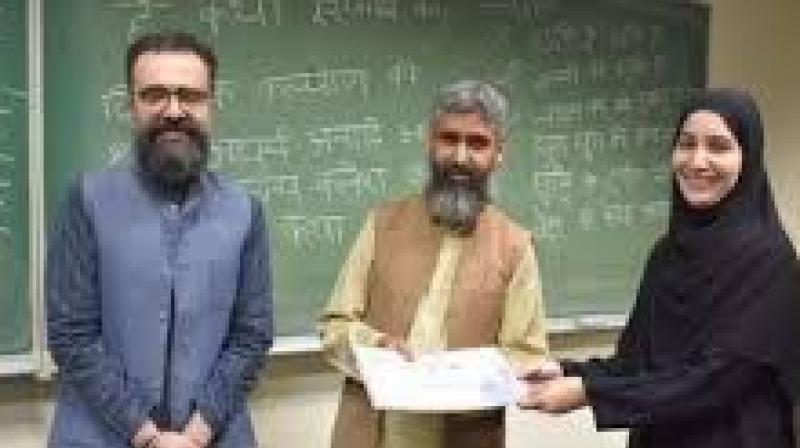
Pakistan has reintroduced Sanskrit studies in its higher education system. In a historic academic development. It is for the first time since the 1947 Partition and a notable shift in cultural and scholarly engagement with the subcontinent’s shared heritage. The Lahore University of Management Sciences (LUMS) launched a four-credit Sanskrit course and elevated what began as a weekend workshop into a formal university offering due to strong student and scholar interest.
Dr Shahid Rasheed, Associate Professor of Sociology at Forman Christian College, is at the centre of this initiative. He has studied Sanskrit extensively, mainly through online resources. Dr Rasheed said that his learning journey started with Arabic and Persian before he took up Sanskrit and reflected his belief that classical languages contain much wisdom for mankind. He continues to deepen his own command of the language even as he teaches it.
The course’s origins trace back to a three-month weekend workshop that drew enthusiastic participation and prompted LUMS to formalise it into a full academic offering. According to Dr Ali Usman Qasmi, Director of the Gurmani Centre at LUMS, Pakistan holds one of the region’s richest but least-explored collections of Sanskrit palm-leaf manuscripts in the Punjab University library. He noted that these collections were catalogued in the 1930s by scholar J.C.R. Woolner, yet Pakistani academics had not engaged with them since independence and left them to be studied mostly by foreign researchers. He said establishing local scholarships will change that dynamic.
Dr Rasheed also addressed questions about studying a language commonly linked with Hindu religious texts and stated it should not be restricted by religious associations. “Sanskrit is the binding language of the entire region. It is ours too; it’s not tied to any one particular religion.” He emphasised that the language’s historical roots in the Indus Valley and the birthplace of grammarian Panini in this region reflect a shared cultural legacy.
The university plans to expand Sanskrit offerings with structured studies of the Mahabharata and Bhagavad Gita, and Dr Qasmi expressed hope that within 10–15 years, Pakistan could produce its own scholars of these ancient texts. Additionally, students in the Sanskrit programme are being exposed to cultural elements such as the Urdu rendition of the Mahabharata theme song “Hai katha sangram ki”, blending classical study with accessible cultural touchstones.
Apart from an academic milestone, the move represents an effort to reclaim and celebrate a linguistic heritage shared across South Asia, potentially fostering deeper regional understanding through the study of ancient languages and texts.
Source: Hindustan Times