

India Secures Strategic Access to European Markets
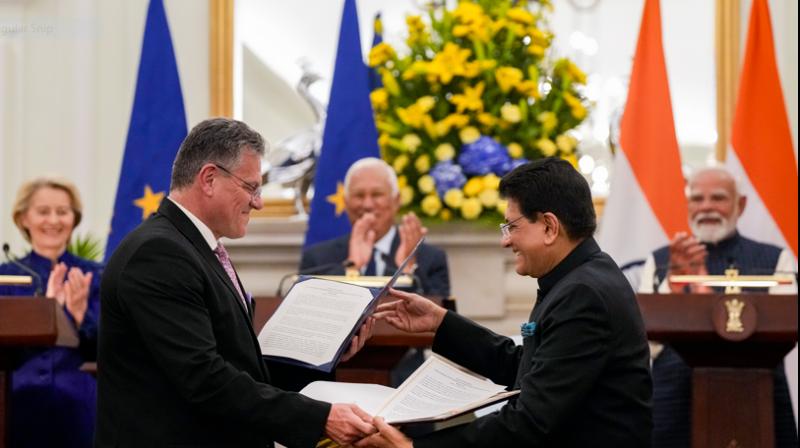
India and the European Union (EU) announced the conclusion of negotiations for a Free Trade Agreement (FTA), an important milestone in one of India’s most strategic economic partnerships. Designed as modern, rules-based trade partnership, the FTA responds to contemporary global challenges while enabling deeper market integration between the world’s 4th and 2nd largest economies.
With a combined market estimated at over INR 2091.6 Lakh Crore (USD 24 trillion), bringing unparalleled opportunities for the 2 billion people of India and the EU, the FTA unlocks significant potential for trade and innovation. The FTA delivers unprecedented market access for more than 99% of India’s export by trade value, while preserving policy space for sensitive sectors and reinforcing India’s developmental priorities.
Bilateral merchandise trade between India and the EU has demonstrated sustained growth, valued approximately at INR 11.5 Lakh Crore (USD 136.54 billion) in 2024-25, with India exporting roughly INR 6.4 Lakh Crore (USD 75.85 billion) to the EU. India-EU trade in services reached INR 7.2 Lakh Crore (USD 83.10 billion) in 2024.
Despite healthy and growing trade, there is a significant untapped potential considering the size of each other’s market and trade. The FTA provides an unparalleled pathway and holds immense promise for both, India and the EU, to emerge as each other’s major economic partners.
This FTA of strategic significance evolves India-EU relations from a traditional into a modern, multifaceted partnership, providing a stable and predictable environment for exporters, enabling Indian businesses including MSMEs to plan long-term investments, integrate into European value chains, and ensure consistent favourable market access amid global economic uncertainties.
Empowering Businesses and Securing Future through seamless Market Access
India Secures Strategic Access to European Markets
India has gained preferential access to the European markets across 97% of tariff lines, covering 99.5% of trade value, in particular:
70.4% tariff lines covering 90.7% of India’s exports will have immediate duty elimination for important labour-intensive sectors such as textiles, leather and footwear, tea, coffee, spices, sports goods, toys, gems and jewellery and certain marine products, amongst others;
20.3% tariff lines covering 2.9% of India’s exports will have zero duty access over 3 and 5 years for certain marine products, processed food items, arms and ammunition, amongst others;
6.1% tariff lines covering 6% of India’s exports will have preferential access by way of tariff reduction for certain poultry products, preserved vegetables, bakery products amongst others or through TRQs for cars, steel, certain shrimps/ prawns products, amongst others.
Key labour-intensive sectors (such as textiles, apparel, marine, leather, footwear, chemicals, plastics/rubber, sports goods, toys, gems, and jewellery), comprising more than INR 2.87 Lakh
Crore (USD 33 billion) of exports that are currently subjected to import duty between 4% to 26% in the EU and are crucial for employment generation, will enter zero duty from entry into force of the FTA and thus gain enhanced competitiveness in the EU market. These sectors are poised to benefit from tariff liberalisation and enhanced competitiveness, enabling deeper integration into global and European value chains and simultaneously creating job opportunities.
India’s offer to the European Union
Overall, India is offering 92.1% of its tariff lines which covers 97.5% of the EU exports, in particular:
49.6% of tariff lines will have immediate duty elimination;
39.5% of tariffs lines are subject to phased elimination over 5, 7, and 10 years’
3% of products are under phased tariff reductions and few products are subject to TRQs for Apples, Pears, Peaches, Kiwi Fruit.
Imports of EU’s high technology goods are expected to diversify India’s import sources, thereby reducing input costs for businesses, benefit consumers and will create opportunities for Indian businesses to integrate into global supply chains.
Driving Agricultural Growth and Farmer Livelihoods, with adequate Safeguards
The FTA is expected to have a significant positive impact on the Indian agricultural and processed food sector. Preferential Market Access for agricultural products like tea, coffee, spices, grapes, gherkins and cucumbers, dried onion, fresh vegetables and fruits as well as for processed food products will make them more competitive in the EU.
This market access will strengthen farmers’ realised incomes, reinforce rural livelihoods, and elevate the global competitiveness of Indian agricultural products.
India has prudently safeguarded sensitive sectors, including dairy, cereals, poultry, soymeal, certain fruits and vegetables, etc. balancing export growth with domestic priorities. The FTA positions Indian agriculture to capture higher value in European markets, drive sectoral prosperity, and reinforces long-term resilience through sustained livelihood and reliable income opportunities.
Product Specific Rules aligned with existing Supply Chains
The FTA ensures that the goods exported under it undergoes adequate processing or manufacturing for them to get the originating status and preferential access. The product specific rules (PSRs) are balanced and aligned with existing supply chains. These PSRs ensure that substantial processing in the Parties is undertaken while providing for adequate flexibility to source inputs from global value chains.
Further, the FTA will facilitate ease of doing business by reducing the time and associated cost of compliance for Indian exporters by allowing self-certification through a Statement on Origin. The PSRs chart an innovative course by considering needs of MSMEs by locking in quotas for shrimps & prawns, and downstream aluminum products which would enable MSMEs to source non-originating inputs. They also incentivise ‘Make in India’ by building in transition period for certain PSRs in the machinery and aerospace sector.
Services-the key growth driver of trade in future
Services being dominant and faster growing part of both economies will trade more in future. Certainty of market access, non-discriminatory treatment, focus on digitally delivered services, ease of mobility are expected to provide boost to services exports.
Under the FTA, broader and deeper commitments have been secured from the EU across 144 services subsectors, including IT/ITeS, professional services, education, and other business services. This covers a vast range of services sectors spectrum in which Indian service providers will get a stable and conducive regime in the EU market to supply their services. India’s competitive, high-tech services are expected to drive India’s exports while benefitting EU businesses and consumers.
India’s offer on 102 subsectors covers EU priorities such as professional, business, telecommunications, maritime, financial, and environmental services. This will offer EU businesses a predictable regime to bring investment and innovative services to India thereby enhancing their exports and providing best in class services to Indian businesses. This mutually beneficial framework is set to accelerate trade in services, unlock new opportunities for Indian professionals and businesses, and strengthen India’s presence in high-value global markets, fostering innovation, skills mobility, and knowledge-based economic growth.
Powering India’s Talent across Europe
The FTA establishes an assured regime for temporary entry and stay for professionals, including Business Visitors, Intra-Corporate Transferees, Contractual Service Suppliers, and Independent Professionals.
Through a comprehensive mobility framework, India strengthens its position as a global hub for talent. The framework eases movement of employees (and their spouses and dependents) of Indian Corporates established in the EU in all services sectors. For business entities aiming to provide services under a contract to EU clients, India can access 37 sub-sectors including IT, business, and professional services.
Independent professionals intending to provide services to EU clients get certainty in 17 sub-sectors for Independent Professionals, covering IT, R&D, and higher education, creating expanded opportunities for Indian professionals and knowledge-driven trade. India and EU have agreed on constructive framework to enable Social Security Agreements in 5 years with all the EU Member States and a continuing conducive framework for entry of India students to study and avail post study work visa.
Expanding Horizons for Indian Traditional Medicine
The FTA is expected to provide a boost to Indian traditional medicine services and practitioners. In the EU Member States where regulations do not exist, AYUSH practitioners will be able to provide their services using the professional qualifications they gain in India.
The FTA also provides future certainty and locks in the openness of the EU for establishment of AYUSH wellness centres and clinics in the EU Member States. The FTA also envisages greater exchange with the EU to facilitate trade in Indian Traditional Medicine services.
Innovate, Protect, Prosper: Elevating Intellectual Property
The FTA reinforces intellectual property protections provided under TRIPS relating to copyright, trademarks, designs, trade secrets, plant varieties, enforcement of IPRs, affirms Doha Declaration and recognises the importance of digital libraries, specifically the Traditional Knowledge Digital Library (TKDL) project initiated by India. The IPR chapter provides for exchanging views and information on their respective laws and practices relating to the transfer of technology, including measures to facilitate information flows, business partnerships, etc.
Strengthening SPS and TBT Links for Safe, Standardised, Seamless Trade
The FTA introduces enhanced cooperation on SPS and TBT matters. It will facilitate recognition of conformity assessment results, enabling equivalence on SPS measures on technical justification and localised responses to pest/ disease outbreaks. Through digitisation, information sharing, and adherence to international standards, the FTA reduces trade barriers, facilitates smoother market access, and strengthens regulatory predictability for exporters.
Sectoral gains under the India–EU FTA
Harvesting Growth beyond Farms: Preferential Access Fuels Agri Growth
India secures preferential market access for its agricultural exports, boosting competitiveness for processed foods, tea, coffee, spices, table grapes, gherkins and cucumbers, sheep and lamb meat, sweet corn, dried onion, and some other fruits and vegetable products.
This will strengthen rural incomes, women’s participation, and India’s position as a premium, trusted supplier in Europe.
Strategic safeguards for sensitive sectors like dairy, cereals, poultry, soymeal, certain fruits and vegetables, etc. ensure export growth while protecting domestic priorities.
Accelerating Exports through Engineering Excellence
With preferential market access for engineering goods presently facing tariffs as high as 22%, the FTA is expected to enhance India’s exports to the EU, which stood at approximately INR 1.44 Lakh Crore (USD 16.6 billion), and improve share in EU’s nearly INR 174.3 Lakh Crore (USD 2 trillion) engineering goods imports. The FTA is poised to empower MSME-led industrial hubs, catalysing industrial modernisation and global competitiveness.
Jobs and Growth: Labour-Intensive Industries Gain Competitiveness
Sectors like textiles, leather, footwear, marine, sports goods, toys, and gems and jewellery gain enhanced competitiveness through tariff elimination, supporting employment generation and EU market integration.
Stepping Up India’s Leather & Footwear exports in Europe
India’s world-acclaimed craftsmanship and MSME innovation in leather and footwear sector, supporting significant employment, is poised to unprecedented leap onto Europe’s stage.
Elimination of tariffs at entry into force of the FTA from up to 17% to zero across all tariff lines will help level the playing field for India’s exports to EU, valued at approximately INR 20.9 Thousand Crore (USD 2.4 billion) and improve share in EU’s nearly INR 8.71 Lakh Crore (USD 100 billion) leather and footwear imports. Regulatory alignment, simplified compliance, and support for design-led, sustainable products will enable a shift from low-margin production to value-added global leadership.
Marine Exports to get a Major Boost
Preferential access covering 100% of trade value, by reducing tariffs of up to 26% will unlock the EU marine market for imports (INR 4.67 Lakh Crore (USD 53.6 billion)). This enhanced market access is expected to significantly improve the competitiveness of India’s marine exports, while complementing and strengthening India’s export capacity in the marine sector, currently valued at INR 8,715 Crore (USD 1 billion) to the EU. The FTA will turbo-charge exports of shrimp, frozen fish, and value-added seafood exports, empowering coastal communities in Andhra Pradesh, Gujarat, Kerala, and beyond and India’s blue economy.
India’s Medical Instruments, Appliances, and Vital Supplies
India’s medical Instruments, Appliances, and vital Supplies built on cutting-edge manufacturing, innovation, and skilled talent is set for a quantum leap in the EU. Tariffs of up to 6.7% eliminated across 99.1% of trade lines, enabling cost-competitive entry in European markets for lenses, spectacles, medical devices, measuring and testing instruments.
Promoting India’s Jewellery Export and creating enormous Job opportunities
The gems and jewellery sector, a blend of artistry, MSME entrepreneurship, and heritage craftsmanship, becomes more competitive in the EU market. From tariffs of up to 4% previously to gaining preferential access across 100% of trade value, India’s INR 23.5 thousand Crore (USD 2.7 Billion) jewellery exports become competitive through the FTA in INR 6.89 Lakh Crore (USD 79.2 billion) import market.
Threading Success: Textiles & Apparel high achievers
Gaining zero duty access in textiles and clothing, covering all tariff lines and reducing tariffs by up to 12%, would open up the EU’s INR 22.9 Lakh Crore (USD 263.5 billion) import market. Building on India’s current INR 3.19 Lakh Crore (USD 36.7 billion) in global textile and apparel exports, including INR 62.7 Thousand Crore (USD 7.2 billion) to the EU, such access would significantly expand opportunities, particularly in yarn, cotton yarn, man-made fibre apparel, Ready-Made Garments, men’s and women’s clothing and home textiles. This would enable MSMEs to scale, generate employment, and reinforce India’s positioning as a reliable, sustainable, and high-value sourcing partner.
Plastics & Rubber exports to benefit extensively
India’s plastic and rubber industries will gain preferential access to the EU, a market with global imports valued at INR 27.67 Lakh Crore (USD 317.5 billion). With India’s current exports to the EU at INR 20.9 thousand Crore (USD 2.4 billion) and total global exports of INR 1.13 Lakh Crore (USD 13 billion), this access underscores substantial scope for growth. Enhanced access under FTA combined with India’s skilled manufacturing workforce and MSME-driven innovation, positions the country to increase employment, boost exports, and strengthen its global trade profile.
Chemicals: Expanding Exports, Generating Employment
FTA ensures zero duty on 97.5% of India’s chemical export basket by value, eliminating duties of up to 12.8% and boosting competitiveness across inorganic, organic, and agrochemicals. The FTA is expected to expand exports, strengthen MSME-led clusters and promote high-value, sustainable, and technologically advanced products, positioning India as a trusted supplier to EU’s nearly INR 43.57 Lakh Crore (USD 500 billion) chemical market for imports.
Unlocking opportunities in Mines and Minerals
Zero duty across 100% of tariff lines breaks cost barriers, ensuring India exports quality, reliable, and value-added minerals to the EU. The FTA unlocks opportunities to scale India’s presence in Europe’s high-value markets, while long-term, predictable access fuels partnerships with European manufacturers in steel, electronics, automotive, and renewable energy.
Significant Market Access for Home Décor, Wooden Crafts, and Furniture
Lower duties of up to 10.5% provides enhanced access, boosting the competitiveness of Indian wooden, bamboo, and handcrafted furniture. The FTA supports growth in high-value, design-oriented segments and strengthens India’s role in global furniture supply chains.
(Source: Ministry of Commerce & Industry)
(For more news apart from “Everything You need to know about India-EU Free Trade Agreement (FTA)," stay tuned to Rozana Spokesman.)